
How Can I Renew My PR Card in Canada?

1. PR Card Renewal with ICAN Immigration Lawyers
If you’re a Permanent Resident (PR) in Canada, your PR Card is one of the most important documents you hold. It’s not just ID, it’s your proof of status, your travel pass, and your way to access essential services in Canada. One thing you must be aware of is that your PR card expires every 5 years.
AS your PR card can expire, get lost, or be damaged, and when that happens, especially if you’re outside Canada, it can cause significant delays or even legal complications.
In this guide, we will walk you through:
- When and how to renew your PR card
- What documents do you need
- Common mistakes to avoid
- What to do if you’re outside Canada
- And how ICAN Immigration Lawyers can help you get it right the first time
2. What Is a PR Card & Why Renewal Is So Important
A Permanent Resident Card is the government’s official document confirming your status as a PR of Canada. It is required in many everyday and critical situations:
- Re-entering Canada via plane, train, bus, or boat
- Enrolling in education or applying for student loans
- Accessing public services such as healthcare and social programs
- Sponsoring family members or applying for citizenship in the future
- Applying for jobs, professional licences, or provincial health coverage
- Proving your legal right to live in Canada
- Showing proof of legal status when applying for jobs, opening bank accounts, or enrolling in education
- Your PR Card expires every 5 years
- As a PR, you are obligated to be physically present in Canada for at least 2 years every 5 years.
Your PR status does not expire, but your PR card does. If your card expires or is invalid, you may face:
- Travel barriers (you can’t board a flight back to Canada without valid PR travel documents)
- Difficulty accessing public services, healthcare, or government programs
- Problems proving your identity or status
Letting your PR card expire can lead to problems with travel, employment, and even accessing your own medical records. Renewing on time and correctly ensures you maintain access to everything your PR status entitles you to. We will guide you when and how to renew, especially if you’re close to expiration or unsure about your residency compliance. This knowledge will make sure you’re never left stranded in or outside Canada. A PR card is also essential when enrolling in educational programs or applying for student loans. If you’re a student planning to stay in Canada for a long time, consider applying for a study permit. Check the Difference Between a Study Permit and a Visitor Visa in Canada, for more.
3. How Long Is a PR Card Valid

Most PR cards are valid for 5 years. In some exceptional circumstances, IRCC issues cards valid for 1 year, for instance, when your status has been reinstated through appeal, or if IRCC wants to monitor compliance more closely in special cases.
The five-year validity ties directly into Canada’s residency obligation: to maintain your permanent resident status, you must be physically present in Canada for at least 730 days (2 years) within every 5-year period. The PR card is the key document IRCC uses to assess whether you’ve met that requirement.
If you have spent significant time outside Canada and are uncertain whether you satisfy the 730-day requirement, it is wise to consult with immigration specialists (like ICAN) before applying.
4. When Should You Renew or Replace Your PR Card?
You should initiate to apply to renew or replace your PR card when:
- It’s expiring within 9 months
- It has already expired
- It’s been lost, stolen, or damaged
- You need to travel outside Canada
- You must prove your PR status for employment or services
Don’t wait until the last minute.
If your card expires while you’re abroad, you won’t be allowed to board a plane back to Canada. Instead, you’ll need to apply for a Permanent Resident Travel Document (PRTD), a more complicated and time-sensitive process.
Permanent Resident Travel Document (PRTD) is a temporary, one-time entry document issued to Canadian permanent residents (PRs) who are outside Canada and do not have a valid PR card to return. PRTD is used only to return to Canada by plane, train, bus, or boat if your PR card has expired, is lost, or is stolen. If your PR card has expired while you’re abroad, you may need a Temporary Resident Visa (TRV) to re-enter Canada. Learn how to apply for a TRV.
5. Who Can Apply to Renew a PR Card?
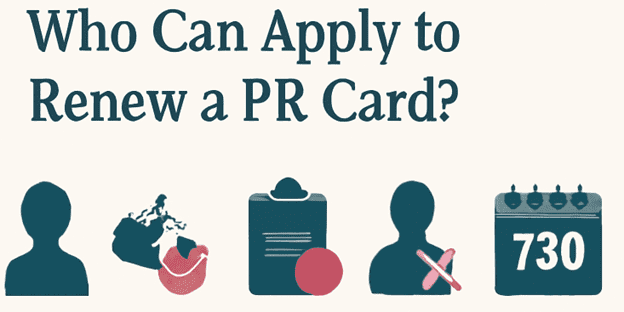
To be eligible to renew your PR card, you must satisfy all of the following:
- Be a current permanent resident of Canada
- Be physically present in Canada when applying
- Not to be under a removal order
- Not a Canadian citizen
- Have met the residency obligation: 730 days in Canada over the last 5 years
If you are unsure whether all these conditions apply to you, or suspect you might have gaps in your residency record, talk to ICAN Immigration Lawyers before submitting your application.
6. Common Pitfalls to Avoid in PR Card Renewal
Thousands of PR card renewal applications are delayed or returned due to avoidable errors. Here are the most common issues:
- Applying too early or too late. Your PR card must be expiring within 9 months, or already expired. If you apply when more than 9 months remain, IRCC may reject or return your application.
- Applying from outside Canada. Renewal applications submitted from abroad are generally not accepted. If you’re abroad and without a valid card, you must apply for a PRTD instead.
- Failing to meet the 730-day rule. If you can’t sufficiently document physical presence in Canada, your renewal may be denied. Don’t guess. Make sure you have proof.
- Lost, stolen, or damaged cards. In these scenarios, you must follow IRCC’s replacement procedure and submit additional documents. Additional Documents to Replace a Lost, Stolen, or Damaged PR Card are:
- Completed IMM 5444 Form (Application for a PR Card)
- Copy of Lost/Stolen/Damaged PR Card (if available)
- Valid Passport Copy
- Statutory Declaration Form (IMM 5451)
- Two Photos (PR Card Specifications)
- Proof of Canadian Residency
- Letter of Explanation (Recommended)
- Payment Receipt
- Submitting incomplete applications. Mistakes such as incorrect photo size, missing forms, incorrect fees, or outdated mailing addresses can cause delays or outright refusal.
- Not Reporting Lost or Stolen Cards Properly. You must include a solemn declaration if your card was lost or stolen and extra documentation to support your identity and status.
Avoiding these errors drastically improves your chances of a smooth renewal. To maintain your PR status, ensure you meet the residency requirements. If you’re planning to apply for citizenship later, reviewing the Mastering Canada’s Express Entry Guide can help you understand the next steps.
7. How to Renew Your PR Card
Below is a structured process for renewing your PR card:
Step 1: Complete the Application Form
- Use the IRCC PR Portal
- Use IMM 5444, available via the IRCC PR Portal
- Ensure all sections are complete
- Sign and date where required
Step 2: Gather Required Documents
- Photocopy of your current or expired PR card
- Two passport-style photos meeting IRCC photo specs
- Copy of your valid passport (photo page + entry stamps)
- Proof of residency (tax documents, utility bills, lease, etc.)
- If your card is lost/stolen: include a solemn declaration
Step 3: Pay the Application Fee
- Processing Fee: $50 CAD
- If biometrics are required: $85 CAD extra
- Pay online and include your receipt
Step 4: Submit the Application
- You must be in Canada
Ensure your address, photos, and all IRCC specifications are met. Remember: IRCC will not accept applications submitted from abroad for card renewal.
- Submit everything through the online PR Portal
Step 6: Complete Document Checklist for PR Card Renewal (2025)
Ensure you have every item below before submitting your application to avoid delays or refusals.
(1) Required Forms and Core Identity Documents
- IMM 5444 – Application for a Permanent Resident Card (renewal or replacement)
- Must be fully completed, signed, and dated.
- Photocopy of Your Current or Expired PR Card
- Front and back. Even if expired, it must be included.
- Photocopy of Passport
- Include bio page and all pages showing stamps, visas, or other markings.
- If you’ve had multiple passports, include all available.
(2) Photos (Strict IRCC Specifications)
- Two identical passport-style photos taken within the last 6 months.
- Must meet IRCC photo specifications.
- Printed on quality photo paper.
- Photographer’s stamp with date on the back of one photo.
Tip: Many delays are caused by incorrect photo sizes. Use a studio familiar with IRCC photo
standards.
(3) Proof of Residency (To Meet 730-Day Requirement)
You must prove you’ve physically resided in Canada for at least 730 days in the last 5 years.
Provide as many of the following as possible:
- Tax Documents
- Canada Revenue Agency (CRA) Notices of Assessment (T1 General).
- Proof of Employment
- T4s, pay stubs, and letters from employers confirming dates of employment and location.
- Lease Agreements or Mortgage Documents
- Rent receipts or ownership documents showing long-term Canadian residence.
- Utility Bills
- Hydro, gas, water, internet, or phone bills in your name with Canadian addresses.
- School Records (if applicable)
- Enrollment letters, transcripts, and attendance records.
Tip: Submit documents that span the entire 5-year period for a stronger case.
(4) Supporting Documents for Long Absences (if applicable)
If you spent long periods outside Canada, you must provide explanations and documentation
showing why you still meet residency requirements:
- Letter of Explanation
- Explain the reason(s) for your time abroad (e.g., family emergency, health, work).
- Proof of Accompanying a Canadian Citizen Spouse Abroad
- Marriage certificate
- A Canadian passport copy of your spouse
- Proof of cohabitation abroad (lease agreements, joint bank accounts, etc.)
- Employment with a Canadian Business Abroad
- Signed letter from Canadian employer
- Work contracts, pay stubs, or tax documents abroad
- Proof employer is registered and active in Canada
(5) Lost, Stolen, or Damaged PR Card – Additional Requirements
If your PR card was lost, stolen, or destroyed, include:
- IMM 5476 (Use of Representative) if you’re working with a lawyer or consultant
- Statutory Declaration explaining what happened to your PR card
- Details: When and where it was lost/stolen/damaged
- Include police report if applicable
- Valid Photo ID
- Passport, driver’s license, or other Canadian-issued ID
- Copy of Previous PR Card (if you have it) or any previous renewal application receipts
(6) Fee Payment
- Processing Fee Receipt
- $50 CAD, paid online at the IRCC Payment Portal.
- Print and include the receipt in your application package.
Note: Biometrics are not required for PR card renewal unless specifically requested by IRCC.
(7) Optional but Strongly Recommended
- Cover Letter
- Short summary of your application and explanation of supporting documents.
- Provincial ID or Driver’s License
- Extra proof of residence in Canada.
- Travel History Report
- From CBSA or IRCC online portal (optional but helpful)
- From the country that issued your passport
Step 6: Wait for Processing
- Average processing time (as of September 2025): 33 days
- You may request urgent processing if you:
- Have a job offer abroad
- Need to attend a funeral or family emergency
- School-related reasons
- Require medical treatment overseas
- Have legal obligations or immigration appointments
📌 Tip: Keep copies of all documents you submit and track your application online via the IRCC portal.
8. What If You’re Outside Canada Without a Valid PR Card?
If your PR card expires, is lost, or is stolen while you’re abroad, you cannot use it to return via regular commercial travel. Instead, you must apply for a Permanent Resident Travel Document (PRTD) from outside Canada.
Key points about the PRTD:
- It is generally valid for a single entry
- The fee is CAD $50
- Applications are processed on a priority basis, but timelines vary
- You must demonstrate that you still meet the 730-day residency requirement
- A PR card cannot be mailed to a foreign address. Plan ahead before traveling
- Processing times vary by country
Essentially, the PRTD is a special emergency pass to get back into Canada, and after returning, you should apply for a new PR card immediately. Having a valid PR card ensures you can apply for provincial nomination through the Provincial Nominee Program (PNP).
9. What Happens If You Don’t Meet the 730-Day Rule?
Failing to meet your residency obligation can lead to the loss of your PR status.
However, in certain cases, IRCC may consider:
- Humanitarian and compassionate reasons
- Time spent abroad while accompanying a Canadian citizen spouse
- Work abroad for a Canadian company or the Canadian government
If you’re short on days, don’t apply blindly; consult an immigration lawyer immediately. Submitting an application while non-compliant could trigger PR status review or removal proceedings.
10. Final Word: Keep Your PR Card and Your Status in Good Standing
Your PR card is a small piece of plastic, but it plays a big role in protecting your rights, travel freedom, and ability to stay in Canada.
If your card is:
- Expiring within 9 months
- Already expired
- Lost, damaged, or stolen
- Or you’re unsure about your residency status
…then it’s time to act before delays or legal risks arise.
10. How ICAN Immigration Lawyers Help You Get It Right

At ICAN Immigration Lawyers, we don’t just help with PR renewals; we guide your entire immigration journey. Here’s how we make the process faster, safer, and more reliable:
(1) Residency Compliance Review
- We analyze your last five years of travel and presence in Canada
- Determine if you meet the 730-day rule
- Suggest legal remedies if you’re short on days
(2) Application Support
- We fill out and review all forms
- Verify documents and photo requirements
- Ensure a fully compliant and complete application
(3) Error Detection & Fixes
- We catch common mistakes that lead to rejections
- Help correct previously returned or refused applications
👉 Book a consultation with ICAN Immigration Lawyers
Let us help you renew with confidence, avoid missteps, and secure your journey from PR status to citizenship.
Frequently Asked Questions
1. What can I do if I stayed in Canada for much less than 730 days?
You may still be eligible if time abroad was due to:
Humanitarian reasons
You should consult an immigration lawyer before applying, as IRCC may review your PR status.
Working for a Canadian company
Accompanying a Canadian spouse
2. Can I renew my PR card if I’m outside Canada?
No. You must be physically in Canada to apply for a PR card renewal. If you’re abroad, apply for a Permanent Resident Travel Document (PRTD) to return.
3. How long does PR card renewal take in 2025?
As of September 2025, the average processing time is about 33 days, though urgent processing is available for emergencies or job-related travel.
4. When should I apply to renew my PR card?
Apply when your card is within 9 months of expiry. Applying too early may result in your application being returned.
5. What happens if my PR card expires while I’m abroad?
You cannot return to Canada using commercial travel. You’ll need to apply for a PRTD through a visa office in your country.
6. What documents are required for PR card renewal?
You’ll need:
$50 fee payment receipt
IMM 5444 application form
Two photos (IRCC specs)
Copy of current/expired PR card
Proof of residency (e.g., tax returns, bills, employment records)
Valid passport copy