Who Can Apply for Permanent Residency in Canada? An Eligibility Check
Canada offers several pathways to permanent residency (PR), each designed for different profiles: skilled workers, tradespeople, recent Canadian work/study graduates, families, entrepreneurs, and select humanitarian cases.
The best route for you depends on your education, language skills, work experience, job offer, and ties to a province. This guide walks you through every major option, the core eligibility factors, and what to prepare. With the right knowledge you can also convert your visitor visa to a work permit.
Snapshot: main PR pathways
Canada’s PR system groups programs into four big buckets:
- Economic immigration: Skilled workers, trades, graduates, and provincial nominees selected for their ability to contribute to the economy.
- Family sponsorship: Canadians and permanent residents reunite with spouses/partners, dependent children, parents, and grandparents.
- Refugee/humanitarian: Protection-based pathways for people who need safety.
- Business immigration: Founders, entrepreneurs, and self-employed applicants who create jobs or contribute culturally/athletically.
For most skilled workers, Express Entry and PNP (Provincial Nominee Programs) are the primary gateways.
Economic programs (Express Entry)
Express Entry (EE) is an online system that ranks eligible candidates and invites the top profiles to apply for PR. It manages three federal programs:
Federal Skilled Worker (FSW)
For skilled workers with foreign or Canadian experience. You’ll be assessed on factors like age, education, ECA (education assessment), language scores (CLB), and skilled work experience aligned with NOC TEER categories.
Canadian Experience Class (CEC)
For people with recent Canadian skilled work experience (temporary workers or post-study graduates who worked in Canada). CEC typically doesn’t require proof of funds if you’re in Canada with valid work authorization when you apply.
Federal Skilled Trades (FST)
For experienced tradespeople in eligible occupations. You generally need either a valid job offer or a certificate of qualification from a Canadian authority, plus minimum language scores tailored to trades.
CRS overview, ITAs, draws
Eligible EE profiles enter a pool and receive a CRS (Comprehensive Ranking System) score. Periodically, IRCC holds draws and issues ITAs (Invitations to Apply) to the highest-ranked profiles or to targeted categories (e.g., certain occupations or language profiles). After an ITA, you submit an electronic PR application with full documents.
Provincial Nominee Programs (PNP)
Every province/territory (except Quebec) runs its own PNP to meet local labor needs. You can pursue:
Base vs enhanced nominations
- Enhanced nominations are linked to Express Entry. If nominated, you get a big CRS boost and apply through EE.
- Base nominations run outside EE. You apply to the province, then use the nomination to apply for PR directly to IRCC.
Job offer vs in-demand occupation streams
Some streams require a job offer from a local employer. Others target in-demand occupations or grads with local credentials. Read each province’s criteria carefully: work experience, language minimums, and intent to settle are typical.
Atlantic Immigration Program (AIP) & RNIP quick notes
- AIP (Atlantic Immigration Program): For designated employers in the Atlantic provinces hiring foreign workers/graduates.
- RNIP (Rural and Northern Immigration Pilot): For employers in participating smaller communities. Community recommendation plus a job offer are central.
Quebec’s programs (separate system)
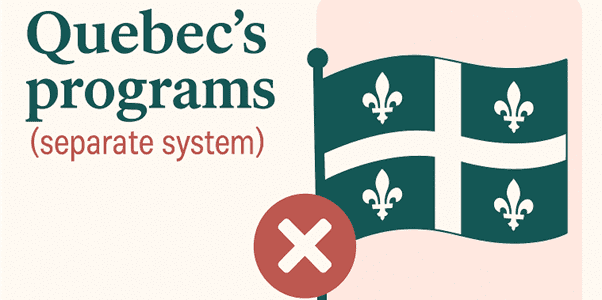
Quebec manages its own selection:
Quebec Skilled Worker / PEQ basics
- QSW (Quebec Skilled Worker): Points-based selection focusing on education, language (French is a strong asset), and work experience.
- PEQ (Programme de l’expérience québécoise): For people with eligible Quebec work or study experience and strong French.
Quebec issues a CSQ (selection certificate) first. You then apply to IRCC for the federal PR step (medical/security checks).
Family sponsorship
If your close family member is a Canadian or permanent resident, they may sponsor you.
Spouse/partner, dependent child, parents/grandparents
- Spouse/partner: Prove a genuine relationship; background checks and basic financial undertakings apply.
- Dependent child: Usually straightforward proof of parent-child relationship and age/dependency rules.
- Parents/grandparents: Runs via intake windows/lotteries; sponsors must meet income thresholds and commit to long-term undertakings.
LICO/MNI and sponsorship undertakings
Sponsors often need to meet LICO/MNI (Minimum Necessary Income) for a set period and sign an undertaking agreeing to support the sponsored relative for several years.
Caregivers & agri-food pilots (if active)
Canada periodically runs targeted programs and pilots for caregivers and agri-food roles.
- Caregivers: Typically require relevant work experience, language (CLB), and a qualifying job role providing in-home care.
- Agri-Food Pilot: For select occupations in agriculture/food processing, often requiring a job offer and industry-specific experience.
Always check the current intake status and caps before preparing an application.
Business & self-employed
If you build companies or contribute to cultural/athletic fields, consider:
Start-Up Visa (designated organization)
PR pathway for founders with support from a designated organization (angel group, VC, or incubator). You’ll need a commitment certificate/letter of support, language minimums, and settlement funds.
Self-Employed Persons (cultural/athletic)
For applicants with relevant self-employment or international achievement in cultural or athletic activities, and a plan to make a significant contribution in Canada.
Owner-operator style options (if applicable)
Direct federal “owner-operator” is not a formal stream; instead, look at provincial entrepreneur programs that require a business plan, investment, job creation, and active management.
Core eligibility factors
Across most economic routes, you’ll be assessed on:
- Age: Points taper with age in EE-linked programs.
- Education: Foreign credentials need an ECA to confirm Canadian equivalency.
- Language: You’ll take approved tests (IELTS/CELPIP for English, TEF/TCF for French). Scores convert to CLB levels.
- Work experience: Must match a NOC TEER category accepted by your program (and meet hour/recency rules).
- Proof of funds: Required for some programs unless you’re exempt (e.g., CEC or you have a qualifying job offer).
- Admissibility: Security, criminality, and medical checks must be passed.
Documents & costs
Police certificates, medicals, biometrics, translations, proof of funds
Prepare police certificates for countries where you lived, complete panel-physician medicals when instructed, and give biometrics (photo/fingerprints). Any document not in English or French needs a certified translation. For proof of funds (where required), provide official bank letters and statements that meet IRCC formatting.
Government fees and typical third-party costs (ECA, language tests)
Budget for IRCC application fees (and a Right of Permanent Residence Fee, where applicable), plus third-party costs: ECA report, language tests, medicals, biometrics, police certificates, and translation/certification fees.
Timelines & success tips
Processing times vary by program, volume, and your file’s completeness. A few practical tips:
- Profile accuracy: In Express Entry, only claim points you can prove. Keep your profile current if circumstances change.
- Job Bank not required: It’s optional for EE; focus on strengthening your profile (language, education, PNP).
- Proof bundles: Organize letters of employment with duties that match your NOC TEER and include hours, salary, and dates.
- Avoid misrepresentation: Errors or omissions can cause refusals and bans. If in doubt, explain proactively with a concise letter of explanation.
- Targeted improvements: Retake language tests, complete an ECA upgrade (e.g., add spouse’s education), or pursue a PNP to boost CRS.
Get in touch with ICAN Immigration law firm today to get premium consultation on moving to canada.
Quick explainers
CLB vs IELTS/CELPIP/TEF mapping
Your test scores convert to CLB levels; programs set minimum CLB thresholds (e.g., CEC vs FSW may differ). If you’re just below a cutoff, a few extra points on listening or writing can push you over a threshold and meaningfully raise your CRS.
Proof of funds amounts & who is exempt
Proof of funds is typically required for FSW/FST unless you’re already in Canada and authorized to work with a valid job offer. CEC applicants usually don’t need proof of funds. Always format bank letters exactly as requested.
NOC classification basics (TEER)
Canada’s occupation system groups jobs by TEER (training, education, experience, responsibilities). Ensure your reference letters show duties aligning with your claimed NOC. IRCC looks at what you did, not just your job title.
Frequently Asked Questions FAQs:
How long does the Canadian PR processing take?
Processing times vary by program, application complexity, and volume of submissions. On average, Express Entry may take 6-8 months, while PNP and family sponsorship may take longer.
Do I need biometrics if I gave them before?
If your biometrics are still valid (less than 10 years old), IRCC may reuse them. If not, you will receive instructions to re-enroll for biometrics at an approved center.
Can I change jobs during PR application processing?
Yes, you can change jobs, but you must report significant changes, such as a job offer withdrawal or role changes. If your eligibility relied on specific job details, changing jobs might affect your application.
What if my passport expires soon during the PR process?
If your passport is about to expire, it’s best to renew it early. The COPR or visa issued by IRCC will have an expiry date linked to the passport and medical exam validity.
When do I get my PR card?
After your landing as a permanent resident and submitting your Canadian address, IRCC will mail your PR card to the address provided.
What is the e-APR, and how do I submit it?
The electronic Application for Permanent Residency (e-APR) is the full application submitted after receiving an Invitation to Apply (ITA) through Express Entry.
What happens after I receive my COPR (Confirmation of Permanent Residence)?
After receiving your COPR, you must land as a permanent resident either virtually (inside Canada) or physically at a port of entry (airport or land border).