Does Canada Have Citizenship by Descent? Rules, Rights, and Process
Yes, Canada recognizes citizenship by descent, but only in limited circumstances. If you were born outside Canada and at least one of your parents was a Canadian citizen when you were born, you may already be a Canadian. The catch is Canada’s “first-generation rule,” which restricts the transmission of citizenship to just one generation born abroad, with narrow exceptions.
Below is a clear guide to who qualifies, what documents you need, how to apply for a proof of citizenship certificate from IRCC, and what to do if you don’t qualify. You can also move to Canada by applying for a TRV and get start the initiation of any procedure there.
What “citizenship by descent” means in Canada
Citizenship by descent means you acquire Canadian citizenship through a parent rather than by being born on Canadian soil or by naturalization. In legal terms, Canada recognizes both:
- Jus soli (right of the soil): almost everyone born in Canada is a citizen at birth.
- Jus sanguinis (right of blood): some people born outside Canada are citizens because a parent was already Canadian.
Quick explainer: jus soli vs jus sanguinis
Canada is mainly a jus soli country, which is why birth in Canada almost always confers citizenship. Jus sanguinis still exists, but Canada limits it to the first generation born abroad to prevent indefinite transmission of citizenship without a real connection to the country
First-generation limit overview
The Citizenship Act was overhauled in 1977 and later amended on April 17, 2009, to introduce the first-generation cut-off for those born outside Canada. In practice, if you are the first generation born abroad to a Canadian parent, you may be a citizen.
If you are the second generation born abroad (your Canadian parent was also born outside Canada), you generally do not inherit citizenship,unless a specific exception applies.
You can also apply for PR after PGWP after your study completion in Canada.
Who qualifies under the first-generation rule
You likely qualify for citizenship by descent if all of the following are true:
- At least one parent was a Canadian citizen at the time of your birth.
This can be a biological parent or, in many cases, a legal parent through adoption (see special cases below). - You were born outside Canada.
- You are the first generation born abroad in your line. In other words, your Canadian parent was either born in Canada or became a naturalized citizen before your birth.
At least one parent a Canadian citizen at your birth
Your parent’s Canadian status must have been effective on or before your date of birth. If your parent became Canadian after you were born, that doesn’t retroactively make you a citizen.
Born outside Canada after Feb 15, 1977 (brief history)
The 1977 Citizenship Act simplified many rules about citizenship by descent. People born abroad before this date face slightly different historical provisions, but the current practical test still revolves around whether you’re within the first generation and whether your parent was a Canadian citizen when you were born.
Who does not qualify (second-generation cut-off)
You generally do not qualify by descent if:
- You are the child of a Canadian who was also born outside Canada.
This is the classic second-generation scenario. You would need another route (e.g., PR → citizenship).
- Your parent’s Canadian status arose after your birth (no retroactivity).
Temporary exceptions (e.g., crown servants)
There’s a narrow exception when the Canadian parent is a crown servant (certain government, military, or similar service abroad) or is accompanying a crown servant at the time. In these cases, the first-generation rule may be treated differently. If this could apply, review the crown servant exception carefully and gather service proof.
Special cases and exceptions
Adoption by a Canadian (citizenship vs PR route)
Canada’s adoption provisions allow many children adopted outside Canada by Canadian citizens to obtain citizenship through the adoption route without first becoming permanent residents. Two important notes:
- The adoptive parent must have been a Canadian citizen at the time of the adoption and meet the legal/immigration requirements for a genuine parent-child relationship.
- The first-generation limit also applies to adopted children. An adopted child who acquires citizenship this way is considered the first generation born abroad and generally cannot pass citizenship by descent to their own children born outside Canada (again, subject to limited exceptions).
Crown servants & accompanying parents
If a Canadian parent is serving Canada abroad in an eligible capacity, their child may have different treatment under the Citizenship Act. Evidence of status, posting, and the child’s connection to the parent during service becomes crucial.
Children born through surrogacy / ART (assisted reproduction)
Citizenship usually follows legal parentage. If you used surrogacy or other assisted reproductive technologies, you’ll need documents proving the legal relationship to the Canadian parent (e.g., court orders, parentage declarations, surrogacy agreements where recognized). Be prepared to submit certified translations and ensure names match across all records.
Proof of citizenship: how to apply
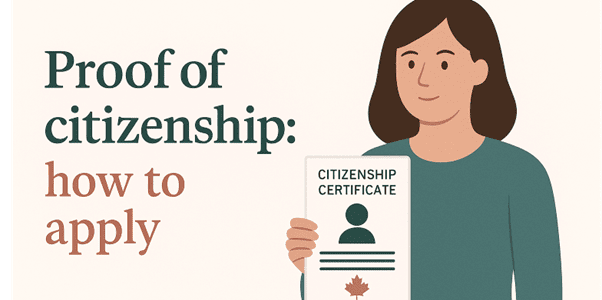
Even if you are already a citizen by operation of law, you won’t have a citizenship certificate until you apply. The proof of citizenship certificate is the official document IRCC issues to confirm your status.
Where to apply (IRCC)
Applications are made to Immigration, Refugees and Citizenship Canada (IRCC). You can apply from inside or outside Canada.
Required documents (parent’s proof, your birth certificate, translations)
Required document checklist
- Completed IRCC application form for proof of citizenship.
- Your full-form birth certificate (showing parents’ names).
- Proof of your parent’s Canadian citizenship (see below).
- Identity document(s) (passport, national ID, etc.).
- Name change or legal parentage documents if applicable (adoption orders, court orders).
- Certified translations for any document not in English or French.
- Photos meeting IRCC specifications (if required).
- Government fee (as listed by IRCC at the time you apply).
How to prove parent’s Canadian status
Acceptable proof typically includes a Canadian birth certificate (parent born in Canada), citizenship certificate, or naturalization certificate. A Canadian passport is useful ID but is not, by itself, determinative proof of status for this purpose. If your parent was naturalized, include the naturalization date (it must be before your birth).
Fees, processing times, and status checks
IRCC posts the current fee and estimated processing time on its website. Times vary based on completeness, authentication needs, and volume. Keep your acknowledgment receipt, and use your IRCC account or provided channels to check status. If IRCC requests additional information, respond by the specified deadline to avoid delays.
Processing time tips (completeness, certified copies)
- Submit clear, certified copies when required.
- Ensure names and dates match exactly across documents.
- Provide long-form civil documents listing parents.
- Use certified translations done by approved translators.
If there’s a complex parentage or service exception, include supporting affidavits and official letters up front.
Common mistakes to avoid

- Using a passport as proof without the citizenship certificate: a passport is evidence of travel privileges, not definitive proof of your citizenship status for IRCC’s purposes.
- Name/date mismatches: even minor inconsistencies can trigger document verification or refusal. Align spellings and provide legal proof of name changes.
- Unaccepted or short-form birth records: IRCC typically requires long-form certificates naming parents.
- Uncertified translations: translations must meet IRCC standards.
- Assuming second-generation eligibility: if your Canadian parent was also born abroad, you likely need a PR pathway instead.
After approval: what happens next
If IRCC approves your application, you’ll receive a citizenship certificate. With this certificate, you can:
- Apply for a Canadian passport (handled by Passport Canada).
- Obtain a Social Insurance Number (SIN) to work or access benefits.
- Register for provincial services like health coverage, subject to residency rules.
Keep your certificate safe; it’s the primary proof of status for life events, employment verification, and travel documentation. You can also get in touch with ICAN Immigration lawyers for detailed assessments and guide.
Alternatives if you don’t qualify by descent
If you’re outside the first generation born abroad, you can still become Canadian, just via the permanent residence (PR) route and later naturalization.
- Economic immigration (Express Entry): Federal Skilled Worker, Canadian Experience Class, and Federal Skilled Trades use the CRS points system. CRS score is very important for Express Entry.
- Provincial Nominee Programs (PNP): Provinces nominate candidates aligned with local labor needs. PNP is a very promising way to gain Canadian entry.
- Quebec programs: run separately from Express Entry.
- Family sponsorship: spouses/partners, dependent children, and parents/grandparents (subject to program caps).
After holding PR for the required time, meet presence and other criteria to apply for citizenship.
Frequently Asked Questions FAQs:
Is Canadian citizenship by descent automatic?
Yes, if you meet the first-generation rule and your parent was a Canadian citizen at the time of your birth. However, you must apply to IRCC for a proof of citizenship certificate.
Does Canada allow citizenship by descent for second-generation born abroad?
Generally, no. The second-generation limit prevents citizenship transmission to those born abroad if their Canadian parent was also born outside Canada, with a few exceptions (e.g., crown servants).
Do I need a citizenship certificate to get a Canadian passport?
Yes. To apply for a Canadian passport, you will need a proof of citizenship certificate from IRCC, as this document confirms your Canadian status.
How long does proof of citizenship take to process?
Processing times vary based on completeness, authentication needs, and IRCC volume. It’s important to follow the document submission guidelines closely to avoid delays.
Can adopted children claim citizenship by descent?
Adopted children can acquire Canadian citizenship if the adoptive parent was a Canadian citizen at the time of adoption. The first-generation rule applies, which means they can’t pass citizenship to the next generation born abroad unless under exceptional circumstances.
What documents do I need to apply for proof of citizenship?
You will need your full-form birth certificate, proof of your parent’s Canadian citizenship, identity documents (e.g., passport), and certified translations for non-English/French documents.
Can I apply for citizenship by descent if my parent became Canadian after my birth?
No. Citizenship by descent requires that your parent was a Canadian citizen at the time of your birth. If your parent became a citizen after you were born, you won’t qualify for citizenship by descent.